
Photo by Joe Santa Maria

Downtown Worcester
Downtown Worcester is a district full of history and character. History buffs will appreciate the significance of the many monuments and statues that adorn Downtown. For generations, the Worcester Oval behind City Hall has been a place for city celebrations and public gatherings, but it is best known for the 12,000 sq. foot public ice-skating rink that is set up every winter. The twinkling holiday lights and crowds of skaters make the Oval a magical place to be during wintertime. Recently, the Oval made its big screen debut in the Lifetime movie, Christmas on Ice.
The Burnside Fountain
Turtle Boy, as it is nicknamed by locals, was commissioned in 1905 as a park fountain that provided freshwater to city residents, dogs, and horses. Today, the statue is one of the most well-known and beloved symbols of Downtown Worcester.

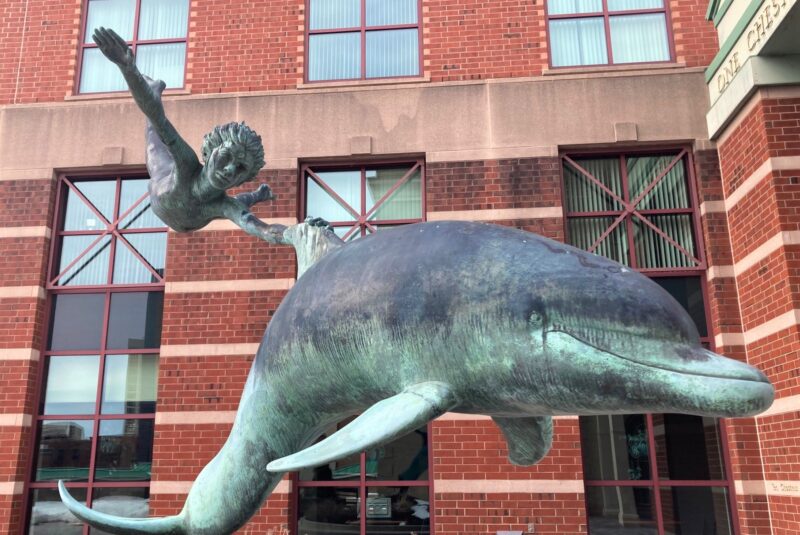
The Boy with a Dolphin
The Boy with a Dolphin statue is another piece of public art that has been defining Downtown for decades. Commissioned in 1974 by famed British sculptor David Wynne, this sculpture appears gravity defining as a young boy catches a ride on a dolphin. Check out this masterpiece at the Chestnut Place courtyard.
War Memorials
Along with incredible, in-the-round sculptures, Downtown also has four war memorials that pay homage to the dedication and sacrifice of Worcester residents. The Soldier’s Memorial was built in 1874 and honors the 4,000 men who represented the Union during the Civil War. Downtown’s World War II memorial is also a beautiful piece of public art with 78 water features that filter through the engraved granite. In 1993, the Southwest Asia War Memorial was created to pay tribute to those who perished in the Desert Shield/Desert Storm Conflict.

The Central Massachusetts Korean War Memorial is an impressive piece of art and a meaningful memorial. It features a life-sized statue of an American soldier as well as a Korean child, representing thousands of children who were orphaned in Korea and saved by American soldiers. In addition to the striking statues and the black granite wall inscribed with soldiers’ names from the Korean war, there is also an engraved brick walkway that allows city goers to see the names of those who lost their lives in Afghanistan, the Gulf, Iraq, and Pakistan.

Union Station
Not just an architectural marvel, Union Station is a vital transportation hub for the entire city. Built in 1911, the train station was crafted in the French Renaissance style. This building features two massive marble towers, granite floors, and ornate filigree details. Worthy of a photoshoot or movie set, Union Station preserves the past while updating transportation services for the city’s growing future. In addition to a train, visitors can also catch a taxi or bus from the station.


